

One of the most common things I hear after a tarot reading isn’t about the cards themselves. It’s a question. “So… what should I take away from all of this?” I think that’s a much better question than asking whether every prediction will come true.
Over the years, I’ve noticed that many people leave a reading remembering one card, one sentence, or one possible outcome. In doing so, they often miss the message the reading was trying to communicate as a whole.
From my experience as a tarot reader and spiritual healer, every meaningful tarot reading has one central message. The cards work together to tell a story.
The challenge is that people often become distracted by the part of the story they were hoping to hear.
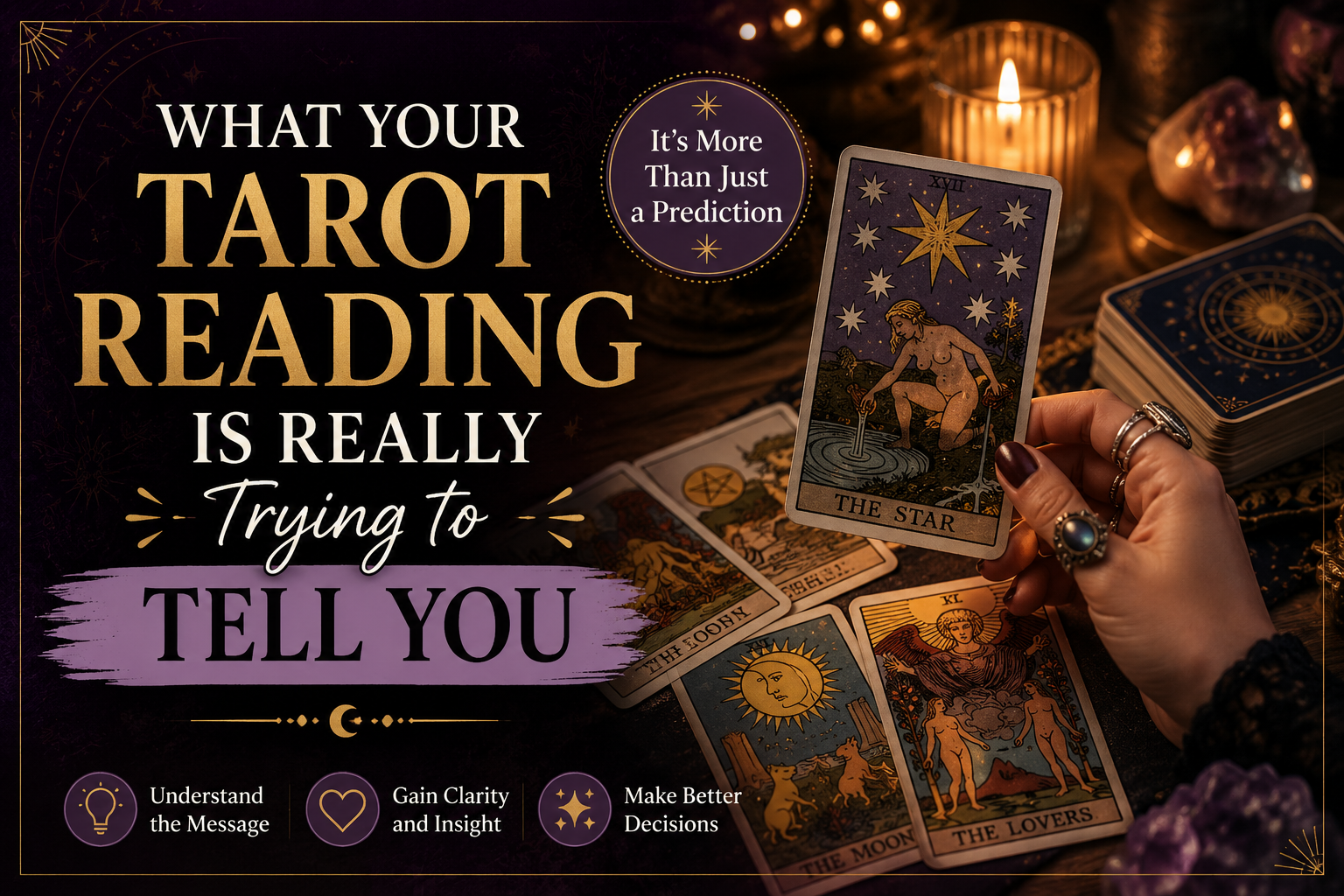
What is your tarot reading really trying to tell you?
If you’ve ever wondered why these insights can feel surprisingly personal, you may also enjoy reading Why Tarot Readings Often Feel So Accurate? Instead of focusing on one card or one prediction, try asking yourself what the entire reading is pointing toward.
That simple shift can completely change how you understand your reading. For example, someone may ask about the future of a relationship.
The reading contains several cards discussing communication, emotional distance, personal boundaries, and trust. Yet when the session ends, the only thing they remember is seeing The Lovers.
They immediately ask,”So does this mean we’ll stay together?” The reading was never only about whether the relationship would continue. It was highlighting the conditions that would influence its future. Those are two very different things.
One thing I’ve learned is that the strongest message in a reading is rarely hidden inside a single card. It usually appears through repetition.
- Perhaps several cards point toward patience.
- Perhaps they all suggest avoiding rushed decisions.
- Perhaps different symbols keep returning to the idea of honest communication.
When similar themes continue appearing throughout a reading, I pay much closer attention to them than I do to any individual card. Those repeated themes often become the heart of the reading.
Another mistake I see is assuming every card is describing someone else.
Relationship readings make this especially common.A person asks about their partner. As the reading unfolds, every interpretation becomes focused on the other person’s feelings, intentions, or behaviour. But tarot doesn’t only reflect the people around us. It often reflects how we are responding to the situation as well.
Sometimes the reading is quietly asking a much more important question.
How are you showing up in this relationship?
That isn’t always the answer people expect. Often, it’s the answer they need most. This is why I encourage people not to judge a reading too quickly.
Some messages make immediate sense. Others become clearer days or even weeks later, after life has unfolded a little further. I’ve had people return and say,
“I didn’t fully understand what the reading meant until something happened afterwards.”
That doesn’t necessarily mean the reading predicted the future. More often, it means they recognised the pattern once they experienced it themselves.
A tarot reading isn’t simply about collecting information. It’s about changing the way you look at your situation. Once your perspective changes, your decisions often change as well. And different decisions can lead to different outcomes.
For me, that has always been one of the most meaningful parts of tarot. The value isn’t found in remembering every card that appeared during the session. It’s found in understanding the one message those cards were trying to communicate together.
So the next time you finish a tarot reading, don’t ask yourself,
“Which card was the most important?” Ask something different.
“If this entire reading could be summarised in one sentence, what would that sentence be?”
In my experience, the answer to that question is often what the reading was trying to tell you all along.
Previous Post
 One of the most common things I hear after a...