

One thing I’ve noticed over the years is that people rarely come for a tarot reading as their first step.
More often, they arrive after asking friends for advice, watching countless tarot videos, reading online discussions, or even speaking with several different readers.
By the time they reach me, they are not lacking information. They are overwhelmed by it.
Why is one tarot reading more valuable than ten opinions?
A meaningful tarot card reading helps you understand the emotional patterns and circumstances behind your situation instead of adding more opinions. While different readers may offer different perspectives, constantly searching for new answers can create confusion rather than clarity. In many cases, one honest reading that encourages self-reflection is more valuable than repeatedly asking the same question in hopes of hearing a different answer.
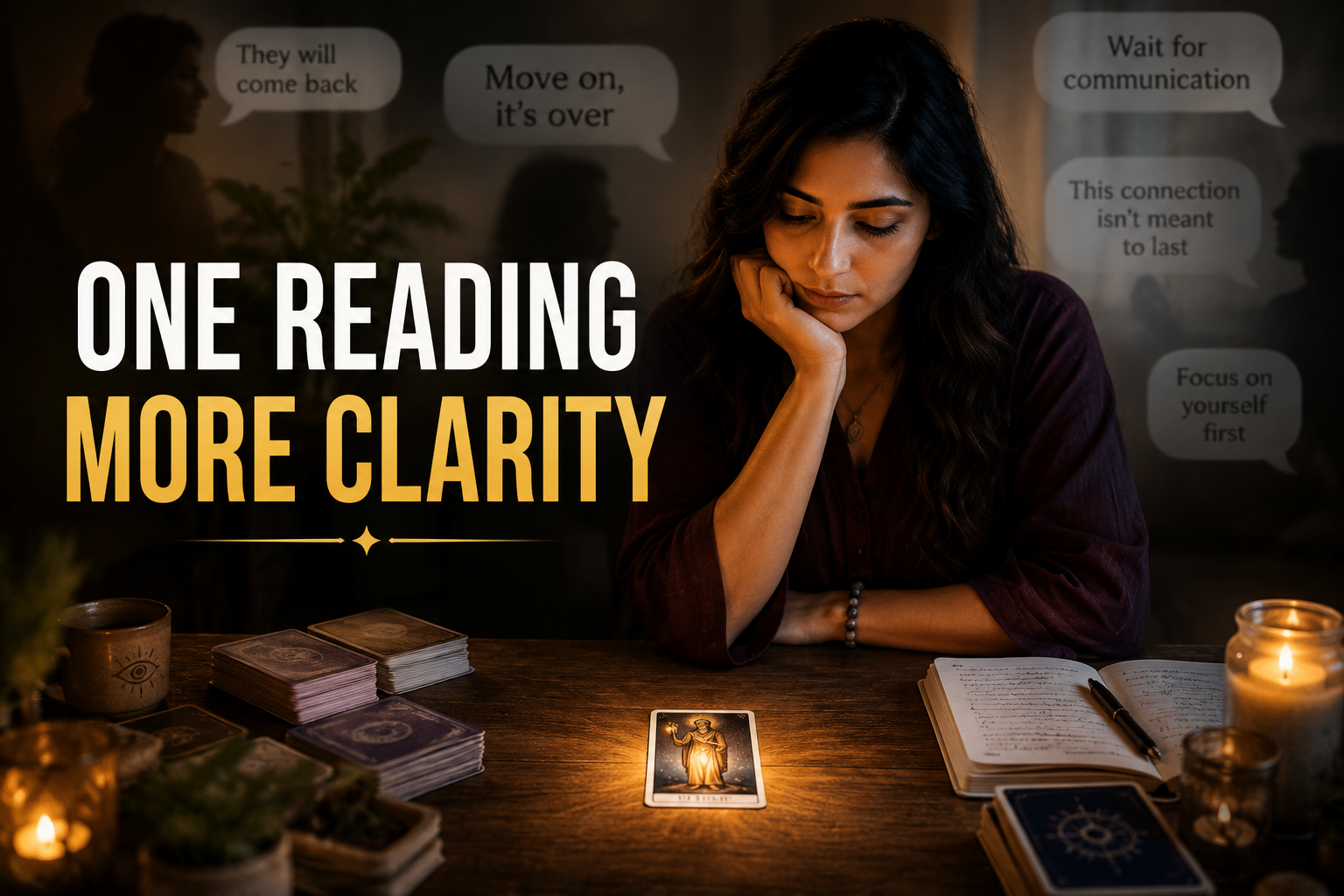
Personally, I don’t think the problem is having too many opinions. The problem is that every new opinion begins pulling them in a different direction.
- One reader says to wait.
- Another says to move on.
- Someone else says reconciliation is possible.
Soon the focus shifts away from understanding the situation and toward deciding which answer feels the most comforting.
That idea connects closely with what I’ve shared in Tarot Readings Often Feel So Accurate, where I explain why the most meaningful readings create self-awareness rather than simply making predictions.
From my experience as a tarot reader and spiritual healer, this is where clarity quietly disappears.
A meaningful tarot card reading is not about collecting predictions until one matches what you hope to hear. It is about slowing down long enough to understand what is actually happening beneath the surface.
That is why I often believe one honest reading is more valuable than ten different opinions.
The purpose of a reading is not to replace your judgment. It is to strengthen it.
When someone keeps seeking more readings about the same situation, I often ask them a simple question:
“Are you looking for a new perspective, or are you hoping someone will finally confirm what you already want to believe?”
The answer usually changes the conversation.
Sometimes the need for another reading has very little to do with tarot itself.
It comes from emotional uncertainty.
When we feel anxious about a relationship, we naturally search for reassurance. Every new opinion provides temporary relief, but that relief rarely lasts. Before long, another question appears, followed by another search for answers.
It becomes a cycle.
I have seen this happen in love tarot readings more than any other type of consultation.
Someone wants to know if their partner will return.
After hearing one interpretation, they immediately look for another.
Not because the first reading lacked value, but because accepting uncertainty is often harder than continuing to search.
Over time, every additional opinion can make the situation feel even more confusing.
This doesn’t mean different tarot readers are wrong.
Every experienced reader may notice different aspects of the same situation. One may focus on emotional patterns, while another pays closer attention to communication, timing, or personal growth.
Different perspectives can all have value.
The difficulty begins when someone compares every reading instead of reflecting on what each one is trying to reveal.
Personally, I have found that the most accurate tarot readings are often the ones that leave people thinking, not the ones that leave them dependent.
A good reading should help you understand yourself more clearly.
It should encourage honest reflection, not endless reassurance.
That is why I always believe the quality of a reading matters far more than the number of readings someone receives.
One thoughtful conversation that brings genuine clarity can be more valuable than ten sessions that simply repeat the same question in different ways.
From my experience, tarot works best when it becomes a moment of reflection rather than a habit of constant searching.
So before booking another tarot reading online or asking someone else for one more opinion, pause for a moment and ask yourself:
“Am I searching for a different answer, or am I avoiding the one I already know deep inside?”
Sometimes, that question brings more clarity than another reading ever could.